Wednesday, 30 October 2019

green roofs at every level

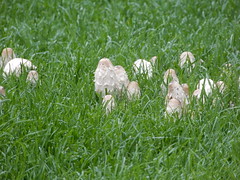
It's been raining for a while now. It's a good autumn for fungus. I was up at Brookes again, and found that the contemplation lawn atop an underground lecture theatre or somesuch has produced a spectacular fairy ring of Ink Caps:a space to push up mushrooms

a space to push up mushrooms   a space to push up mushrooms

I know it was originally intended as a meditation lawn, but in practice everyone gives it the same careful berth accorded to any Oxford quad. I can't see anyone daring to dart out to pick these for a fry-up, though Ink Caps are quite tasty (though you must cook them immediately, before they dissolve into black goo).

The actual roof-level green roof is showing signs of wear and has the gardeners in. This is a beauty in season, teeming with Yellow Rattle. I quite like it in the October rain too; joining in the symphony of grey-green-browns.

green roof maintenance

green roof maintenance   green roof maintenance

There's still too much hardstanding around the John Henry Brookes building for my taste, but plants are given a limited priority. And there are green roofs, at different levels.

Sunday, 27 October 2019

Roll out the green carpet

You catch a glimpse of something wonderful on Twitter, in this case someone giving Regent's Street (is it? I'm far from fluent in London skylines) a pedestrian makeover, and my first thought is who made that?
In the thread, @fietsprofessor drops in an attribution (good man) to @London NPC and I discover it's actually Fleet Street (my bad) and spend a few clicks on their website finding treasures like the Greenground map and a guide to making your own pallet bench and sweet snippets like there being nearly as many trees as people in London, and it being home to 15,000 species. But the videos on view are all in the standard high quality community engagement genre beloved of small-scale film companies across the country - perfect for loosening funding bids or being shown in assembly, but not what I'm after.

To the London National Park City* Media tweets then, to see if I can find it again. Yes, and they credit @watgdesigns who do get up to some lovely stuff (I've linked you to their media page again), but you might also want to check their very sci-fi Urban projects page.

Sadly, no sign of a little gallery of animations like this one, greening the grey of London's streets. Which is a shame, because I suspect the original digital artist who made it did not limit themselves to just one.

Back in the copy art days, my friend Al did a series of these kinds of items (static of course, and on postcards, the status updates of their day) which stripped cars and tarmac from the roads of Oxford, substituting greenery and exotic wildlife, parrots on Cowley Road and penguins in Cornmarket.

That view of the city that is not as it is, but as you would have it be. 

Wednesday, 23 October 2019

I grew it on the allotment

Grown this year (I'd hesitate to say successfully....)

  • French bean
  • Sweetcorn
  • Radish
  • Yellow onion
  • Red onion
  • Beetroot
  • Broad beans
  • Potatoes
  • Sage
  • Carrot
  • Shallot
  • Horseradish
  • Red Orach
  • Strawberries

I made it up there in a tiny stretch of civic twilight this week, just long enough to plant broad beans between the bee (or wasp) holes. I cleared a few weeds from the bed, but also left some - the chickweed is still in flower, late nectar for October insects.

The list above looks impressive, but for some things I only got one item; the singular bean and sweetcorn in the picture, for example. Others did quite well --  more radishes than one person could eat, onions aplenty, sweet and delicious.

The most consistent and reliable crop, however, remains the couch grass.

Sunday, 20 October 2019

semi-abandoned concrete planters

On Tidmarsh Lane, just beyond the Registry office, the Beton Brut of Macclesfield House (which the current owners have tried and failed to have knocked down with a 21st Century glass thingy) drifts out into the verge with a series of defensive planters before-the-fact, though honestly you'd struggle to dent that massive wall, or reach the tiny, solid windows through it (maybe it was the demolition bill estimate that gave the redevelopment pause).

Concrete planters, semi-abandoned

With County Hall, and the now very much redeveloped Westgate Centre, these buildings were a slabby, utilitarian, defiantly future-orientated retort to the tourist chocolate box aesthetic that dominates the city centre. Late 60s, shading into the flashiness of early 70s, they featured futuristic details like travelators and geodisic domes, secret gardens and innovative utility systems.

They were also built to last, as were these planters, that aren't really maintained any more, but still look pretty fabulous. This one holds a fig:

Concrete planters, semi-abandoned

This one some kind of hardy Lonerica that honestly may be struggling a bit:

Concrete planters, semi-abandoned

This one has lost its shrubs, but gained a scraggle of Michaelmas Daisies, along with the rubbish from the people who can't tell a planter from a rubbish bin.

Concrete planters, semi-abandoned

The steady rewilding of these planters (for that is what is happening here) is periodically interrupted by a stealthy daff , tulip or sunflower from one of Oxford's plentiful guerrilla gardeners. A stealthy green outcreep surrounds them as soil washes out slowly through the drainage holes. Central Oxford is weeded, but this may just be beyond the reach of the hoes and the weed-torches; or it may count as Macclesfield House, and therefore be caught in a state of uncertain maintenance as these planters probably aren't crucial to incubating businesses, which is what the building is doing now.

Wednesday, 16 October 2019

catching up on some small green stories from the summer

With the heating on, and my feet firmly in slippers, having determined that the day is too wet for the allotment, it's time to catch up on a few bits and bobs I never quite got to this summer.

1. Birds and the Built Environment

Driving to London

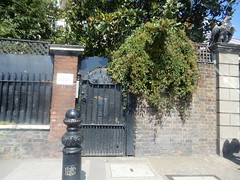
I have some aerials, in fact quite a few, on the chimney of my house. One is tilting somewhat, so I had been considering getting them taken off. They do nothing any more, after all. Everything comes in via the cable or mobile. But I also regularly spot birds using them as perch. If I get rid of them, am I inconveniencing my local Jackdaws, Crows, Goldfinches, Starlings and Magpies? Is there such a thing as a decorative aerial for birds? (Google sent me straight to pigeon spikes, so maybe not!)

2. London Grown Over City

Driving to London Driving to London

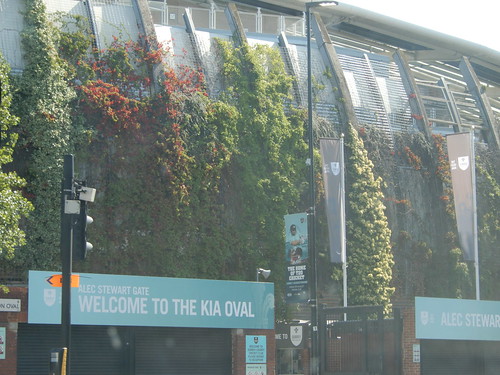
3. The Kia Oval Green Wall

Driving to London

Not every day you see this sort of thing looming up above a street. I'm delighted to find that there's some technical specs for this (not to mention lovely hi-res images) online - find out more about Barnshaws and their unrivalled in-house cold bending capacity.

4. 2019, the year fruit withered on the tree

Desiccated fruit Desiccated fruit
It's been a very difficult year. All my grapes failed, through a combination of receiving too little water, then too much. It's a much less pretty sight than these pretty prunes and raisins at a friend's house.

5. Ivy bees have invaded my allotment

Allotment wildlife

Ivy bees have a tiny sting that feels a little like a nettle with only one spine. I found this out pulling up the gone-over radishes. I noted that there were a bunch of odd-looking holes in the bed, but carried on anyway, and eventually a bee took objection.

Or, alternatively - it's actually Digger wasps, and one of the nests had been provisioned with a half-dead Ivy Bee. Either way, I have a lot of these holes in most of my flower beds.

Both promise interesting displays if I leave them till spring, but I'm worried that it'll look like I've abandoned the allotment entirely...

Sunday, 13 October 2019

urban greenvasion: green line planting

Meet one of our local thin green lines:

green lines

It's been a wet, warm month, so growth like this is everywhere. Every crack, every crevice is sprouting green. Wherever there is a seam in the seamless urban environment, green is zipping along it, opening up a tiny garden space for weeds and algae, moss and muck.
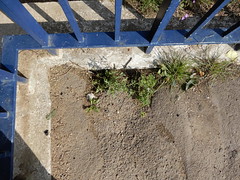
green lines green lines

And then comes the grass, levering the tarmac apart, opening up cracks in the pavements, harbinger of dilapidation. Nobody wants this, so out come the municipal hoes and blowtorches, if you're lucky, weedkiller if you're not.... which is a shame, because every single one of those tiny green straps, small pink or white or yellow flowers is a stepping stone for insects, for pollen beetles and bees, for hoverflies and tiny wasps, buzzing deep into our cities. Every crack and crevice picks up those particulates we'd otherwise be breathing and makes them into mulch for the green. They're quite nice to look at too, or is that just me?

Crickets.

Just me then. But wait, maybe we could make them into something a bit more intentional, and a bit more lovely, but keep the appeal to our native insect life? And maybe these thin green lines could be pressed into service as tiny threads for our smallest animals to flit and crawl and creep along through our concrete wastelands?

Stick with me, because my idea is something a lot smaller and easier to maintain than a green wall. It's more akin to a cornice, a dado, a picture rail. These planting spaces bolt onto walls, or nestle in their angles. They don't have much soil or water in them, so they're going to only take the hardiest of the hardy. How fortunate that this gives us so many beautiful and wonderful plants. All of our native weeds can mingle in with dwarf grasses and hardy alpines, Erigeron rubbing up against Golden Marjoram and House Leeks, Yorkshire fog and Timothy grass rubbing up against Sow thistle and Willowherb and hardy, grow-anywhere dandelion. It could be awesome. Consider this view:


Pretty dull, right?  Let's add a planting rail everywhere there's a seam in the dollhouse bricks:


As you can see I went quite complicated on the near wall, with a varied planting and a deeper trough, but kept things very straightforward on the ups and downs of the far wall, with just a tight little plastic planting medium holder planted with vigorous grasses and weeds. Much better, and you can feel the moist soil cooling the walls, the insects bumbling along those lines. Pigeons would perch on them, probably even nest in some of them, and you know what that means; guano.

So, what do we need to get from here to there?

  • A range of green line products to be available in the eco or building trade, boltable to walls, with a well-sealed back, sufficient drainage and water retention to look after itself once attached, ideally made of recycled plastic, with enough give in them to take plant growth and the occasional self-seeder.
  • Urban wall pocket seed mixes that combine weeds and hardy plants sensitively to create a fast growing and self-sustaining plant mix suitable for wall and crevice growing.  
  • A maintenance contract for yanking out the buddleia, willow, cotoneaster, firethorn, hawthorn and lonerica once it gets too big for the planting space, say once six monthly, plus the at-height green workers to deliver this.
  • A shift in attitudes from seeing buildings with plants on them as dilapidated to seeing them as doing their carbon duty and performing well.
  • A tolerance of weeds, bugs and mini-beasts in the urban environment, because this item is likely to dribble woodlice, spiders and earwigs, as well as seeds and weeds, onto the pavements below. 
But on the whole I'd say it's worth it. Green walls are an irrigation pest, their drama and beauty prone to failure if their water goes. But it doesn't have to start that big. Let's formalise the thin green lines already snaking through our environment, and join them up with improvised green snakery lurching across our buildings, bridges, towerblocks, shopping centres. Let's scribble on the city with mossy green crayon and grassy green magic markers and weedy coloured pencils. Let's outline everything with a fringe of greenery.

Let's look to a future where a centipede can cross a city on a tiny green tightrope, without ever having to put its feet on a road, a wall, a building. 

Let's draw a thin green line.

Wednesday, 9 October 2019

vegetable passion, stitchless fashion

I've been looking at fashion shows again. It's an old habit born of shivering in west country boarding houses dreaming of glamour unattainable in the brief two hour windows that I could score in the local small towns. Of course back then I had to squint at tiny photos in magazines in newsagents and bus stations. Now it's all there, at the touch of a button, to scroll endlessly or have delivered in tidy insta-packages. Then, as now, I was always delighted to find someone throwing plants into the mix.

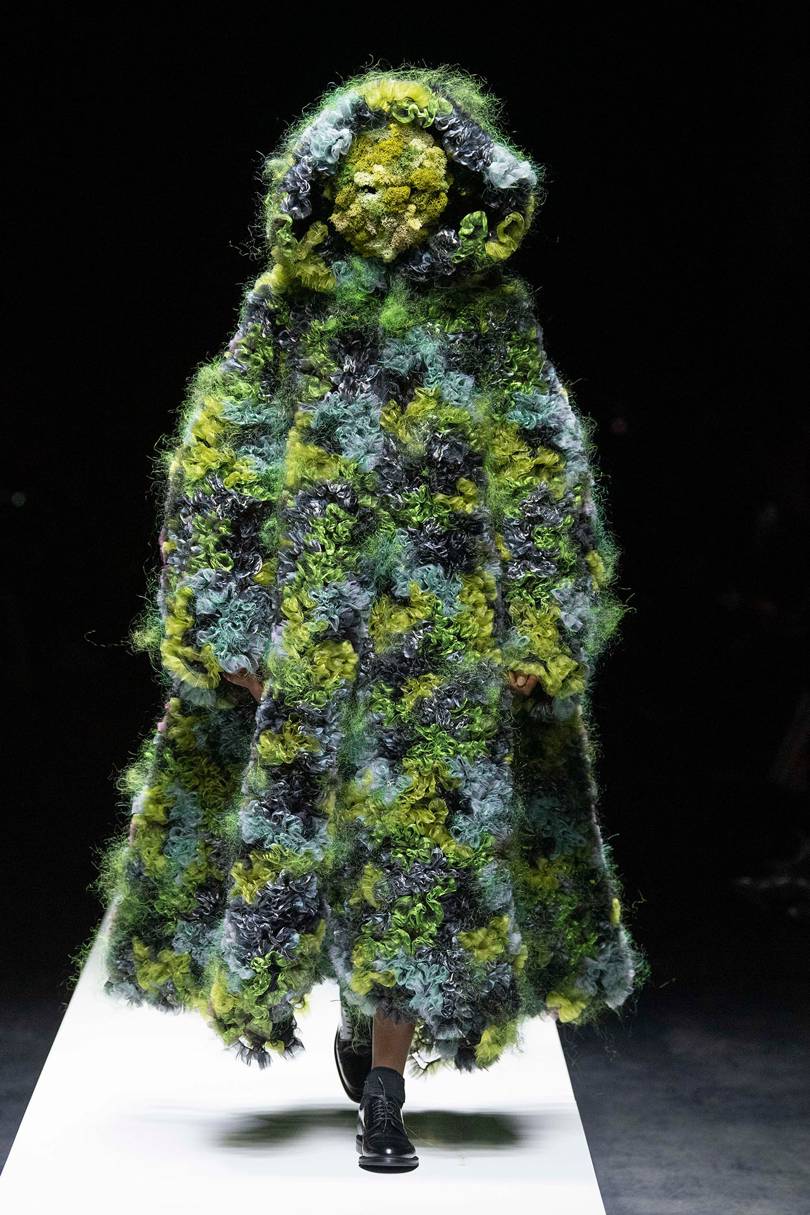
Welcome to the hallucinatory forest garden world of Noir Kei Ninomiya:


As you can see, he has a light side and a dark side. Not to mention a savagely weird side. The faces obliterated by vegetation, the mysterious cut fabrics, all hint at a future where humans and plants lie much more intimately together.


This is human as vase, human as flower bed, human as potting medium. What grows on you enhances you. The plant is with you and in you and on you.


I'm sad to be missing Halloween this year. I can't think of a lovelier thing to dress up as. I normally pop on an owl mask for the trick or treaters. How much lovelier to pop on a lichen mask, or wear tiers of mist and clouds:


I love the way the models appear more than human, too; as in this video where they dress in rain and scatter their seeds wide across a warehouse full of fashionistas, like fabulous, feisty willowherbs.