Thursday, 9 March 2023

I'm living in my own private orchid festival

I didn't make it to the Kew Orchid Festival this year. Again! As my calendar reminds me. But there's this:   


And also this:  


And this, still rattling on, though getting on a bit:


Supermarket Moth Orchids, bought on reduction, nursed through the darkness of interior life.

Monday, 6 March 2023

reindeer crossings and my desire to put beards on bridges

 There's  nothing new about the concept of bridges for animals. From motorway stock bridges to wildlife crossings from reindeer ("renoducts")  to green bridges for grizzly bears, to naturbrugge for wild boar and red deer. They exist and they make the long dark wall of a motorway or an interstate feel less barrier-like, less vast. But natural movement erodes a bottleneck. Could something this narrow cope with wildlife at undepleted levels? A herd would not interpret this as a safe space. 

Lots of people are looking at the problem. Meet Saferoad, whose manifesto is straightforward:

  • prevent wildlife mortality due to animal-vehicle collisions;
  • assure that the barrier effect of roads is reduced sufficiently to maintain viable wildlife populations, such as the construction of wildlife crossing structures
They're researching it, by the way. Not doing it. Wagendingen University are also on the case:

"It is still unclear how effective wildlife bridges and other wildlife crossings are, and whether recreational use of wildlife bridges can be combined with a function as a wildlife crossing."

Also researching it, not doing it. But plenty of people are drawing green lines across the grey of road barriers. It's the next logical stop after the signs telling us to watch out for wildlife crossing. 

fine strung bridge two
Green painted bridge over a dual carriageway. 

Bridges are expensive. I've had many a conversation with a despairing colleague who is being batted back again and again as as they try to argue that humans need a bridge out of their road-bounded no-facilities new-build estates. Footbridges: too expensive, insufficiently accessible, not absolutely necessary and therefore dropping off the end of the job list. 

Risky, too, those bleak open spaces above the zooming traffic. I once saw a kid up on one exuberantly flossing at the traffic height of the Fortnite craze and what if I hadn't caught the cultural reference? What then?

If only there were a way to combine the wildlife bridge and the human bridge, while making both safer, less bleakly open to the noise and space, while keeping the bulk of animals away from our favourite terrifying carnivorous ape, the human being. If only there were some way to bring more funding and kudos onto the act of building bridges, and stop them being the job you give the least civil engineer, the architect on the bottom of the monkey tree....

Which brings me to the next proposition:

We really need bridge merkins. No, hear me out. Let's take another look at that bridge, or another, similar one (I photograph lots of bridges).

Slightly out of focus motorway footbridge with graffiti on retaining wall

We're looking up from underneath at a space that could potentially hold a pathway. Let's suspend planters along the sides, down and out of reach of the scary humans or any road traffic above. Let's link them with a concealed, small safe space, a wildlife run. Let's make sure this is inaccessible to humans with a decent, high barrier above. It'll double as a trellis, further engaging the greenery and creating an insect-friendly route across the roadway.


Under-bridge planting trough and vegetation roughly photoshopped on underside of bridge 

As you can see in the image, water dripping down and vines hanging down might create hazards. However, the disturbance of traffic should keep the space clear, so bar a cut or two it should be as manageable as a rural road. 

Maybe it would be better to call them bridge beards. The alliteration works. They could work as a retrofit or a new build. They might even make bridges a calmer, cooler, quieter space to be and encourage more people (as well as animals) to take that walk to the far side of the tarmac ocean, to see what they can see. 

Thursday, 2 March 2023

continuous impenetrable glass walls and tiger stripe cities

 Like many people, I have over the years read many iterations of future cities, utopian, dystopian, and all the strange shadings inbetween. Science fiction brings them, but so do books about city planning, old consultation documents, proposals and all the other attempts we make to put a constructable pattern on the future. Trees and the city, in all their many patterns.

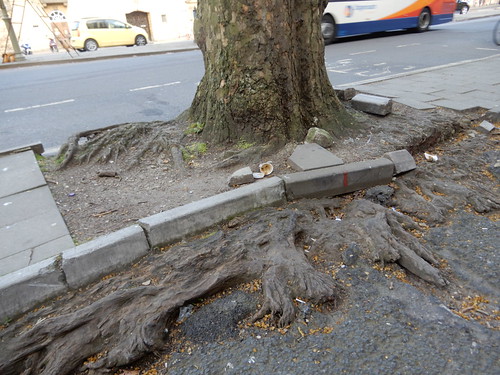
escaping tree roots

At the moment there's a lot of attention being paid to non-bounded cities. On one side we have the greening of the city: trees and shrubs entering the cities like long green chains along waterways and verges, along garden-chains, green edge alleyways house fronts and backs, with its attendant benefits of air cooling and freshening. Trees cool spaces, not least because in order to have a tree in the first place, you need things like adequate space, suitable surfaces, a decent water supply. But trees also fight, with utilities, boundaries, smooth surfaces. They buckle the plazas and make pavements swell, unnervingly. Maximum cooling for minimum disruption is the aim, but the tree is an entity in itself, and whether it sprawls out of control or sullenly declines is not altogether in the planter's control.

sky windows

On the other we have the continent spanning imaginary megacity, a glass and steel wall of hyperconnected futurecity that puts human first, the continuous city of Neom, slicing through the desert. There's a nervousness around this, but the natural world washes around the new environment, growing novel bacterias around sewage outflows, hardy mosses on reservoir overflows. It may not be wildlife documentary-style, but it's wildlife nevertheless.

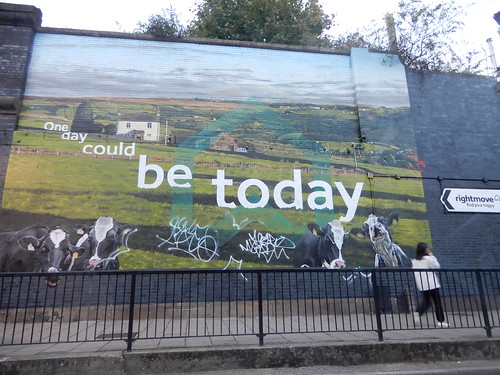
could be today

Friday, 24 February 2023

february in the garden

 It's been a warmish month, and the flowers have come on fast, indoors and out. February in the garden has brought snowdrops and bulbicodium daffodils outside, orchids inside.


I've felt frustrated by the level of flowers; mostly because it's against a bit of background of tragedy; Pieris gone, Bay Tree gone, my 20 year old rhododendron, gone.... 


There a sense of pallor about the flowers that come up in early February, the snowdrops and the early iris, the hellebore. So pale, so interesting, so vague in the gloomy half-light of January. Thank goodness for the Bulbicodium, a tiny hoop petticoat daffodil that is like cheerfulness in flower form.


Finally comes the Fuji Cherry, which I'm sure was called something else back when I bought it. It's increasingly dissatisfied with life in the pot so I'm tempted to set it free this year. The little black flower on my lockdown bench is a garden regular.


Friday, 17 February 2023

we are all transmission vectors for the seeds of weeds

 As a pet owner, one of my regular activities is deburring. In comes one of the furry ones, pleased as punch, carrying a little freight of seeds and burrs discovered in my garden, the next garden, the verge, the scrub behind the wheelie bins at the back of the estate.

They find them at all times of year, even the depths of winter. 

The standard weeds and seeds I brush from everything are like a skipping rhyme: Creeping Buttercup, Couch Grass, Enchanter's Nightshade, Barley Grass, Wild Oats,  Alkanet, Euphorbia, Herb Robert.

The plants my garden would be, if I'd just stop planting all that other stuff in them.

travelling in space and time

Plants, the odd exception notwithstanding, are rooted to the spot. 

But they travel far and often very fast, either generationally, in the form of seeds, or as fragments, as many parts of a plant can can take root spontaneously. They travel by wind and water, and in the stomachs of animals. They travel on you, on me.

Don't think they travel on you? Think again. Scientist carefully vacuumed samples of clothes and bags on visitors to Antarctica, and found (in common with most animals, the wind, duck's feet and indeed rocks) humans are a vector for plant propagation.

Visitors carrying seeds average 9.5 seeds per person, although as vectors, scientists carry greater propagule loads than tourists. Annual tourist numbers (∼33,054) are higher than those of scientists (∼7,085), thus tempering these differences in propagule load. Chown et el 2012

Even among the small numbers of seeds I handle, many of them are as small as dust. The ones that come from my orchids and airplants - smaller. Me and my furry assistants scampering round in service of our vegetative overlords, scattering seeds as we go.
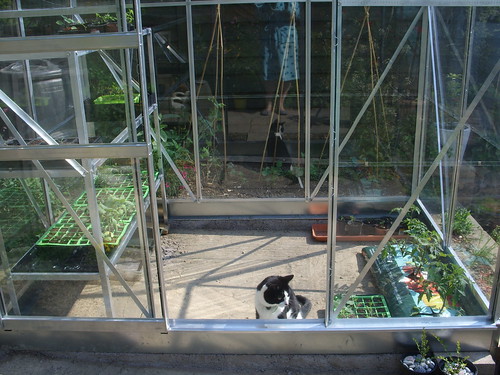
what's in the greenhouse?

Of course it is always important to read the research in the context of its funding. In this case, this useful summary provided by IATTO (International Association of Antarctica Tour Operators) is instructive. But it's also important to look at it in the context of prejudicial attitudes.

a world of rats and sparrows

Adverts for cruising to Antarctica bookend my experience of wildlife documentaries nowadays. The value of knowing something exists is intensified by experiencing it, seeing it, and yes - smelling it; and so we go, and so we look, and dandelions bloom in our footprints.

There's a pile of concern, but it brings discomfort, to me; a lot of the guidance and guidelines and studies come down to; I should be allowed to travel. But not you.... and that is a difficult position to take. 

Wind blows, birds fly, humans travel; and all of us with seeds in our feet, our feathers, our hair, under our nails and in the air in our lungs.

We breath in the fresh air of a new city, and breathe out orchids. 

Wednesday, 15 February 2023

last february in the garden

 Last February in the garden was a distracted time. I was drawn away by stuff happening elsewhere and urgent. See Feb 7: "overwhelmed by it all".

Gardening record calendar February 2022

A few things are still in my worry list: "Spriggy looking thin". This is not referring to the width of my privet hedge, but how well leaved it is. In winder nowadays it looks twiggy and a bit bare. It's still there, plus the topiary chameleon is becoming misshapen. Time for a change?

"Happier up ladders" is nice to see. I was terrified of working at height after the post-stroke treatment left me fainting. But "kept dropping twigs on face" suggests that the visual field problems were still bugging me a lot. 

Finally: "are there wild hellebore?" Yes, my hellebore are self-seeding nowadays. Like my year-on-year Nigella, I can see how the fancy hybrids produce a simpler plant, ;less doubling, clearer, smaller, paler blooms. Not wild yet, but the beginning of the process of feralization.

Tuesday, 7 February 2023

a count is as good as a kill

I've been re-reading the screenplay of a film I was very fond of, The Falls by Peter Greenaway. This is a surrealist experimental series of 92 short films about a "violent unknown event" (VUE) which was possibly the fault of birds (but perhaps not) and provoked a medical catastrophe for a subsection of humans who found themselves medically, emotionally, physically and linguistically changed by an event they could not understand.

Here's the trailer:

THE FALLS (Peter Greenaway, 1980) from Spectacle on Vimeo.

I was thinking about it in relation to two things, the first being The Big Garden Birdwatch and the second being the RHS calling on people to record weeds. In The Falls, naturalism is viewed with suspicion, the counters and the recorders and the observers interrogated for their intentions, with parallel drawn to hunting, and the cruelty of nursery rhymes, where birds die, repeatedly, fall, inevitably, stanza upon verse upon repetition upon rhyme. 

One of the touchstone phrases in the The Falls is: a count is as good as a kill. This runs both ways; it is as good for the person (the twitcher, the birdspotter) to check the bird off the list, as to shoot it. But also the act of counting is often one of disturbance and distress: mist-nets, rings, the adrenaline rollercoaster of capture and release, and the invasion of your territory and space by giant carnivorous apes might not kill you, but it's not great for you either.  It's a stressor. It really is. 

And also for plants of course. Observation, handling, noticing, spotting. None of these actions are possible without changing what is observed. The act of study changes what it observes, and that change can easily include damage. But it's still better for the plant than yanking it up, pulling it out, burning it and destroying its seeds. A count is as good as a kill for the human doing the counting.

But for the thing being counted, it's definitely the better option. 

Luke and Leia