Wednesday, 19 May 2021

urban cliff hypothesis

Back in 2021, sick from blood loss and illness, and mired in the sticky silence of lockdown, I read about the urban cliff hypothesis in a column by Alys Fowler (this is another infill post, written in February 2023 from the barely-there notes I took at the time).

"the urban cliff hypothesis that suggests our cities are surprisingly similar habitats to rock faces, that our homes still resemble caves, and that the plants and animals that thrive in our harsh cityscapes evolved from those natural places: species such as rock doves (pigeons), goat willows, buddleia and red valerian."

Links are from the original column, which was mostly about gardening when your garden is a small patch of concrete, or a windowsill. 

Barren Rock Ecosystems. Urban Cliff Hypothesis. Three word agglomerations. Trendy apartment buzzwords. But also; it is my biome.

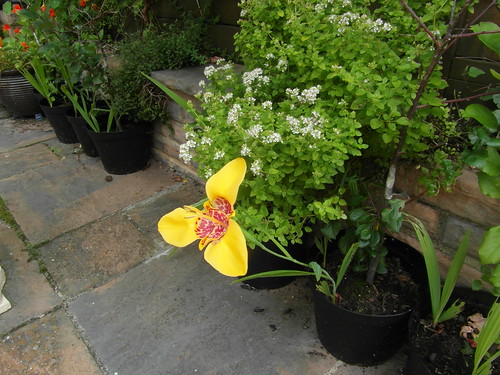
My garden is a freshwater cliff and stone pavement environment. It doesn't have a visible stream, but both our position on a slope down to a confined waterway and the column of midges that gathers at the front corner of my back patio is suggestive of something part spring-line, part ancient water-pipes. The pebble dash is skittered over by squirrels and perched on by sparrows. Doves and pigeons coo in the chimneys. Oregano and Thyme do well, as you'd expect, but Thrift hates it - not quite bright enough to go coastal. Though the odd shade-loving exotic does well, and brings a pleasing sort of rock-jungle-stream vibe. 
whoa!!!!

With her usual tendency to find something bizarre and left-field, Alys includes a name-check for Geranium robertianum 'Celtic White' which is a sport of the pink weed that grows everywhere and kills whatever it's growing with. No word if the white one is as murdery, but although colour sports are sometimes less vigorous, I'm disinclined to make the experiment, not least because they smell of armpits.

I'm going to stick with my junglicious brights looming out of my shady, tree-buried space, as the animals flicker and skitter over the rocks, the trees, and kites quarter the upsky, looking for the abandoned kills of domestic cats.

Tuesday, 27 April 2021

shuttered concrete fantasies

 This beautiful arrangement from London Flower School popped up in my instagram feed.

Thought the flowers are lovely, it was really the concrete containers that caught my eye. Click through to the post and you'll see people asking about them. Supplied by the wholesaler florist who supplies their flowers, apparently. Eye catching and attractive. At least in the pictures. As s a recent run-in with a provider of innovative plant pots from a popular online re-seller has taught me, the online picture is an approximation: the real item may disappoint. I wouldn't mind some shuttered concrete planters, though they look like they may fight with all but the smoothest of ground surfaces.

This is their last post but one; the look of concrete and not its reality: maybe an easier proposition.

This year, it's time for a pot audit. As ever, a bunch of items shuffled off during the winter/spring -10 ° cold snap. Including my pound-shop camellia, sadly. Some pots broke apart in it, too. But honestly the main reason is: I need the patio space. I need space for bubble parties, projections, socially distanced visitors, rehearsals.

Time to get the plants out of the pots and into the ground. Where possible, of course. I have suspicion also that some of them (a Phygelius sucker smuggled home in a coat pocket, a fig in a tough metal trough that is nevertheless looking suspiciously happy) have punched through the bottom of their containers, and the patio too.

The beds are also full, of course, but I'm sure I can squeeze a few more in, if I try.


Sunday, 14 March 2021

light that grows plants in the night

 This light installation is very pretty, isn't it? Be aware that its author is a utopian artist and a company called Biolumic who are developing the light delivery technology.

Of course, supplementary lighting has been a commonplace of glasshouse growing for many years. Here is Agriculture Canada in a delightfully utopian period piece uploaded years ago.


What is (not particularly) new here is the idea that you can boost productivity, increase pest resistance, boost growth etc. through "light recipes". LEDs, as anyone who has ever tried to match four bulbs after one has died knows all too well, come in all of the colours. White from warm to cold, and everything else as well. These purplish colours seem popular. I remember them at The IKEA Future garden at Chelsea 2019:

IKEA Future Garden IKEA Future Garden

IKEA Future Garden IKEA Future Garden

You can buy IKEA grow lights, as well as many cheaper solutions of course. Many are purplish. 

I don't have anything beyond a bright tube light in my verandah (the main indoor plant space). Maybe I should get them some supplementary lighting? Bet the tomatoes would appreciate it.

Sunday, 21 February 2021

robots that plant trees

Like many people, I've planted a few trees in my life. A sycamore, when I was a child, on the farm, in a place we needed a bit of water draw and shelter. A Spire Cherry and a Magnolia in a corner house that needed a bit of wow factor. Some hedgeable British natives (Elder, Hawthorn, Hazel, Holly, Field Maple etc.) in gardens that needed wildlife-friendly sheltering boundaries. 

I'm hardly unique in this, lots of people enjoy planting trees, which is why I was a bit puzzled by the robot that plants trees. But then I started thinking about wildlife disturbance, about how often planted trees fail, about how volunteer humans might somewhat maximise the disadvantages of human-planted forests in terms of disturbance and inefficiency. Might there be a better and less disruptive way?

You'll want a slightly expanded view of the product at this point, and Interesting Engineering have a brief overview of the tree planting robot and its brush cutting chum. (Anyone thinking "ooh that sounds a great way to clear established native scrub and replace it with fast growing commercial wood product" quell your cynicism briefly please.)

There's also a video (yes that's a Facebook link) which you can leave running in the background as there's not much look at - just talking heads. But I am put in mind of a few things. 

Firstly: a tale of two hedges I heard somewhere. The first was planted carefully by foresters, to give a good and careful mix of appropriate plants for the area, protected from deer and rabbits, fed through lean times and watered through dry patches and it grew into a fine and beautiful hedge. The second was created by a busy farmer. He hung a washing line between two trees, near to where there were some old trees growing; a scrappy hawthorn, an elder tree that had sprung up from somewhere, a rough old bird cherry and a hazel, where the squirrels would pick up their nuts for winter. All winter the birds that fed in the trees sat on the line as they flew from tree to tree, picking up nuts and berries. They sat and shat. The seeds rained down, each fertilised tidily on the way down. And as time went by, seedlings sprouted up under the line, and the squirrels started to use is as a run-along, and then the mice and you know what? To cut a long story short, both the hedges did just fine.

Secondly: the way woody weeds sprout from every corner of my garden. Squirrel planted hazels, pigeon planted cherry laurel, starling squirted elder trees.

Let me whisper it quietly: you don't even need the line. Trees will grow if you don't cut them down. Thickets and scrub will skin over the soil. You might need to limit the access a little bit for rabbits and deer - or you could just let brambles or anything else thorny grow to take care of that. Leave the space. The forest will grow.

And if it's not growing, it's likely something else needs fixing other than planting trees.

in the jaws of the hedge

Sunday, 14 February 2021

cold weather gardening

There's not much to do when the weather is like this. But I still have a brown bin to fill so I cut my vine. Since the stroke I'm banned from ladders as the drugs I'm on = low blood pressure = risk of fainting, but fortunately I had a pole lopper lurking in the shed, so snip snip, down it came. 

Last year's brutal combination of snaps (cold, wet, dry, etc.) had left me unripe grapes rotting on the branches, so I'd ignored them in the hope that they'd at least be decent fodder for some overwintering animal or bird. Nothing wild had so much as touched them (bar the moulds - they had had fun) so into the brown bin they went with the rest of the branches. 

I filled my brown bin, which was enough to lose all my body heat. I feel the cold a lot more now than I used to before the stroke. I trimmed off the top of the tallest rose. But I baulked at clearing away the rough overgrowth of perennial weeds (bindweed, willowherb, long purples, etc.) from the big bed. Under the brown were hellebores coming through the angle, and the dead and desiccated overgrowth of weeds was giving them a modicum of protection from the bleak midwinter.


I'm glad I left it. This week was the hard frost week, the proper winter week, the week where I knock out a perfect disc of rock-solid ice every morning from the bird bath and through the week they accumulate, mysterious disks on my sere winter front bed. But still the hellebores persist, in muted colours, heads dropped modestly and safely down, so that frost and snow won't foul their delicate parts. 


Hellebore breeding has been quite wild in recent years, but though I have few of the fluttering, ruffled types (I bought a nursery six-pack from an impulse display one year, and they are establishing, slowly, alongside the older varieties shown here) I favour the classic plant, an open face, a flower almost dropped back to the greys, browns and muted greens of winter, that soft February palette that is waiting for the bright brushstrokes of spring proper.

The whisper, where others shout. But they still say: spring is coming.


Sunday, 7 February 2021

air plants

Some xmas money finally got spent - on air plants. Craftyplants - a favourite since I found their stall in a marquee at a garden show, fondness consolidated when I saw them appear on Gardener's World - have delivered me some new plants to fill some new containment devices

This Tillandsdia Albida has a lovely silvery shimmer. Flower spikes are cream and red, which sounds amazing, but I'm unlikely to be provoking flowering for a bit. It's a fast grower, and I fancy waiting till it's a bit more chonky.

There's actually a variety of this Tillandsia Albertiana called "Mystic Trumpet" but that was out of stock! Never mind, I rather like this soft little mass of fronds, which was already enthusiastically dividing itself in two, having presumably decided to put on a growth spurt in transit.

Now for the fancy one - Tillandsia Tricholepis. It's a small variety, so unlike the other two, will remain delicate, although apparently it's madly promiscuous, pupping all around the place, which sounds fun.Yellow flower on this one, if it gets happy.

Of course then the heating promptly broke, the temperature plummeted, and it started snowing, but hopefully they'll get through that. Nice soak in water (I use water from my electric dehumidifier at this time of year, which is clean and soft) and then off to get settled in.

Happy 2021, air plant family!

Wednesday, 3 February 2021

an act of faith in the summer to come

Sweet peas can famously be planted any time from October to May, and though you might want to go early or late for best results, I find the act of planting in deep midwinter irresistible. There's so little going on elsewhere in the garden. Doing almost anything involving soil will churn mud monstrously. You can hack and chop, certainly - but there are invertebrates sheltering everywhere.

So, the sweet peas:


Nicky's Nursery still have a good choice available if you want to do some midwinter planting (or spring planting) of your own. I got Velvet Crush - not a variety, but a very sweet mix - a lovely looking lavender blue called Bristol, and a favourite of mine called Blue Shift which is pretty much a candyshift of pink and purple. They're going into a root trainer, you can see it under the packets. 

Next up: the propagator, for the chilli seeds (that's probably what the fourth packet is, in case you're wondering).